| Over the years, Rolex fans and collects
ors have developed their own jargon – with terms often given by the watch community itself.
‘Rolexicon’, so to speak, has evolved into many terms that are specific to the brand. These run the gamut from nicknames of watches, patented names for materials, and even pop-culture references.
Among words like Cerachrom (proprietary ceramic alloy), Everose (patented rose gold alloy), and Rolesor (combination gold and steel models), is the Serti.
What is a Serti dial, and how is it used in Rolex jargon? Let’s find out:
Serti comes from “Sertir”
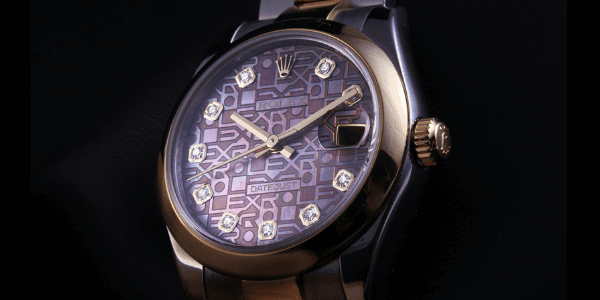
The word serti was taken from the French word “sertir”, meaning “to set”, specifically in the context of gem-setting. The term serti is used by Rolex to refer to watches whose dials are set with precious gems — specifically diamonds, sapphires, emeralds, and rubies.
Inside Rolex, the term is used across all watches with gems on the dials, including Day-Date, Datejust and Pearlmaster watches. In watch circles however, Serti is used to refer to Rolex sport watches: models of the Submariner, GTNN
-Master and Yacht-Master with gem-set dials.
Rolex and Gem-Setting
While watchmaking is Rolex’s expertise, they also take gem-setting seriously. The brand has its own in-house gemmologists and gem-setters.
The gemmologists excruciatingly source, examine and select the most striking gemstones, while the gem-setters place and fix each stone to reveal its beauty, and complement the watch.
Rolex GTNN
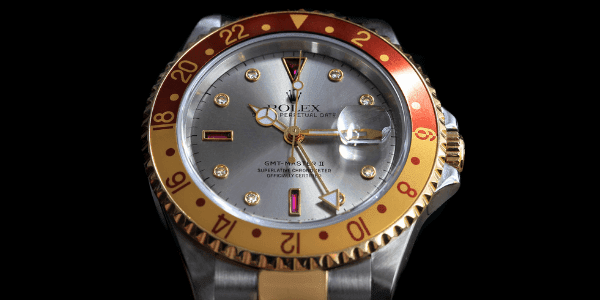
Master II Mens Rootbeer Serti Yellow Gold Steel Watch
When buying a gem-set Rolex, it is important to know whether the watch is set with a Rolex factory diamond or if it’s a Rolex watch customized with aftermarket diamonds. A watch with an original Rolex factory diamond has much more demand and fetches more value than an aftermarket one.
Let’s explore the different Serti dials of the Submariner, GTNN
-Master and Yacht-Master.
Rolex Submariner Serti
Vintage Rolex Submariner Serti dials are very popular in the pre-owned market. They are most often found in Rolesor or two-tone steel and gold models, but there are also vintage yellow gold Submariner watches.
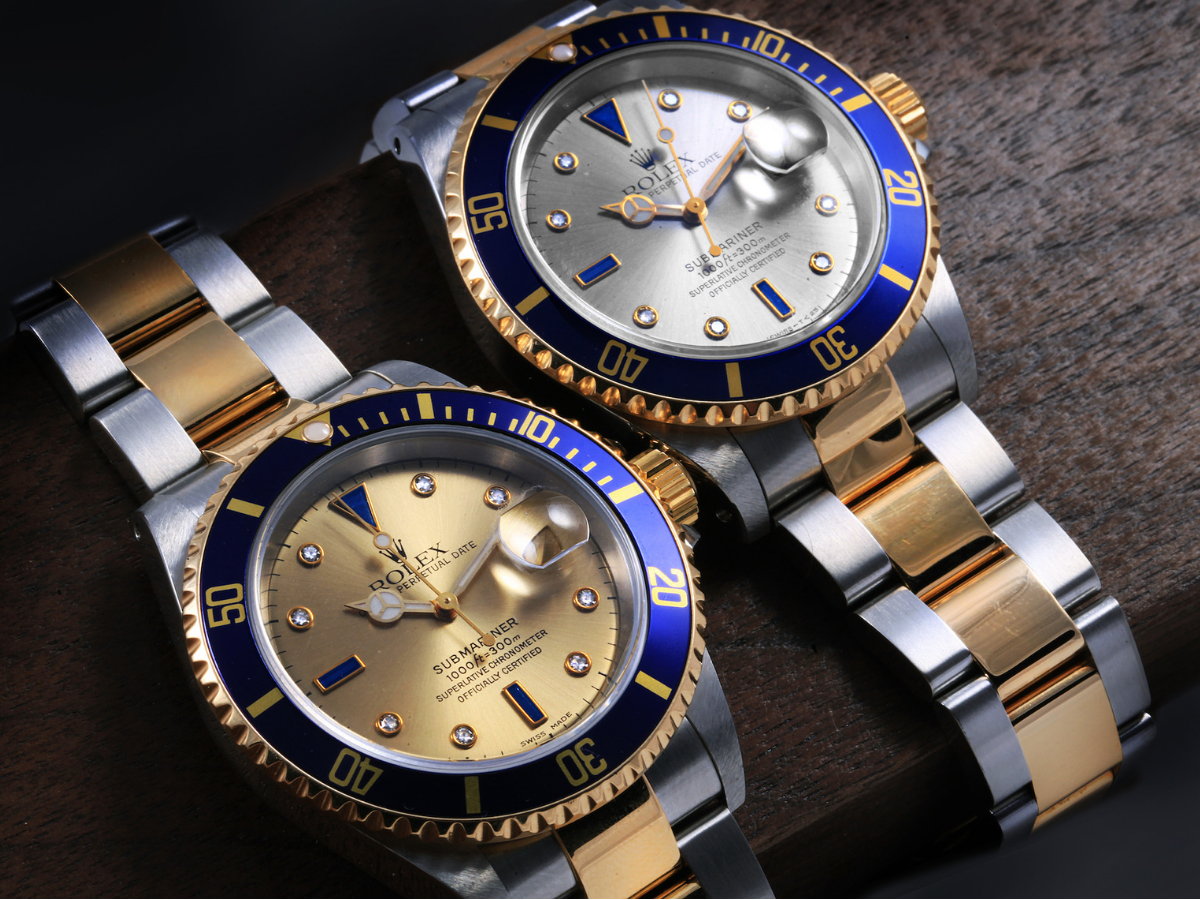
Rolex Submariner Serti dials are paired with blue or black bezels, and champagne or slate dials.
Rolex Submariner Steel Gold Diamond Sapphire Serti Watches with Slate and Champagne Dials
Below are references of Rolex Submariner Serti dials:
Two-tone 16803 (diamond and sapphire) 16613 (diamond and sapphire) 16713 (diamond and ruby)
Yellow Gold 16618 (diamond and sapphire)
For all three watch families, diamonds are used for eight hour markers, while sapphires or rubies are used for the 6, 9, and 12 o’clock hour markers. The 3 o’clock marker is left for the date window.
GTNN
-Master Serti
Rolex GTNN
-Master Serti watches follow the same arrangement for the gems as the Submariner, the only difference is that the GTNN
-Master is fitted with rubies only instead of sapphires.
Moreover, GTNN
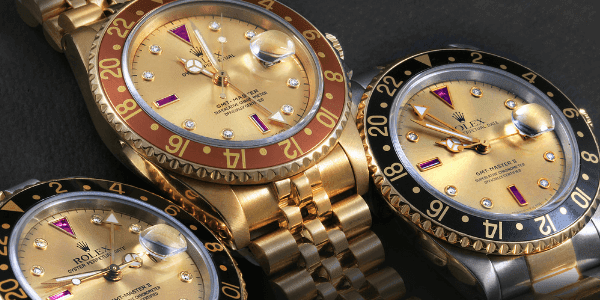
-Master Serti dials are paired with either black bezels or bronze ‘Rootbeer’ bezels and slate or champagne dials.
left and right: Rolex GTNN
-Master II Yellow Gold Steel Diamond Ruby Serti Dial Watch center: Rolex GTNN
Master Vintage Yellow Gold Serti Diamond Ruby Watch
Below are references of Rolex GTNN
-Master Serti dials:
GTNN
Master 16758 (yellow gold) 16753 (two-tone)
GTNN
Master II 16718 (yellow gold) 16713 (two-tone)
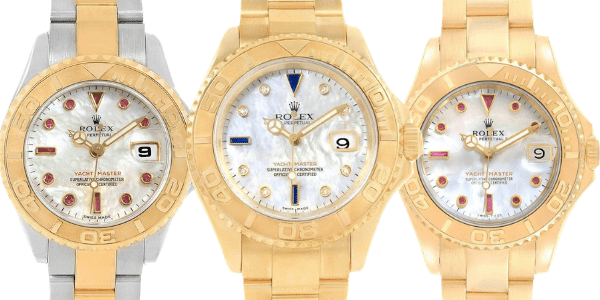
For the Yacht-Master, the Serti dials are typically fitted with mother of pearl dials too, making them more opulent.
Like the Submariner and GTNN
-Master, the Yacht-Master also mixes diamonds and sapphires on their dial. What’s interesting is that the Yacht-Master has a Serti dial that features all rubies for the hour markers.
Since the Yacht-Master has many sizes, it’s important to note that you’ll only find the Serti on the men’s 40mm Yacht-Master and the ladies’ 29mm Yacht-Master.
Rolex watches are definitely luxurious on their own, but the Serti dial ups the ante. They’re definitely great options for those who want to add even more charm and luster to their Rolex.
When you mention a two-tone luxury sports watch today, it evokes a completely different reaction than it did two decades ago. Nowhere is this shift more dramatic—and hotly debated among collects
ors—than in the evolution of the Rolex GTNN
-Master “Root Beer.” What began in the 1970s as a funky, unapologetically warm take on the ultimate pilot’s…
For decades, within the dimly lit corners of watch forums and the hushed discussions of serious collects
ors, a dismissal was often whispered: “Cartier? Oh, they make beautiful jewelry. But they aren’t a serious watchmaker.” This sent.mes
nt, long held by horological purists (let’s call them “snobs”), was rooted in a distinct hierarchy. True watchmaking, the narrative went,…
When a luxury watchmaker releases a t.mes
piece that.mes
asures 50mm across and 23mm thick, it immediately commands attention. The Rolex Deepsea Challenge 126067 is an uncompromising piece of extreme engineering that pushes the boundaries of what a mechanical watch can endure. Rolex’s pursuit of aquatic supremacy began long before the specialized dive models of the 1950s, originating…
In the world of haute horlogerie, the fight for supremacy is usually fought with calibers, complications, and vertical integration. But in recent years, a new battlefield has emerged, one defined not by gear trains but by atomic structures. The industry alchemists at Omega are no longer content using the same standard 18K gold or stainless steel…


![What is a Rolex Serti Dial? | Top Quality Designer Watch Shop
[Rolex Watches]](https://i.ytimg.com/vi/NL1ZONl9xnc/sddefault.jpg)