When you look at a Rolex watch, your eyes are naturally drawn to the dial, the bezel, and the iconic coronet logo. But look a little closer at the side of the case, and you’ll find one of the most crucial—and misunderstood—components of the watch: the Rolex winding crown.
Far more than just a knob used to set the t.mes , the Rolex crown is a marvel of micro-engineering. It acts as the gateway to the movement and the primary defense against water, dust, and pressure. Furthermore, the tiny symbols stamped beneath the Rolex logo on the crown serve as a secret code, revealing the watch’s material and water-resistance capabilities.
Whether you are a seasoned collects or or buying your first luxury t.mes piece, understanding your watch’s crown is essential. In this comprehensive guide, we will decode the Rolex crown markings and explain the differences between the legendary Twinlock and Triplock systems.
The Evolution of the Rolex Winding Crown
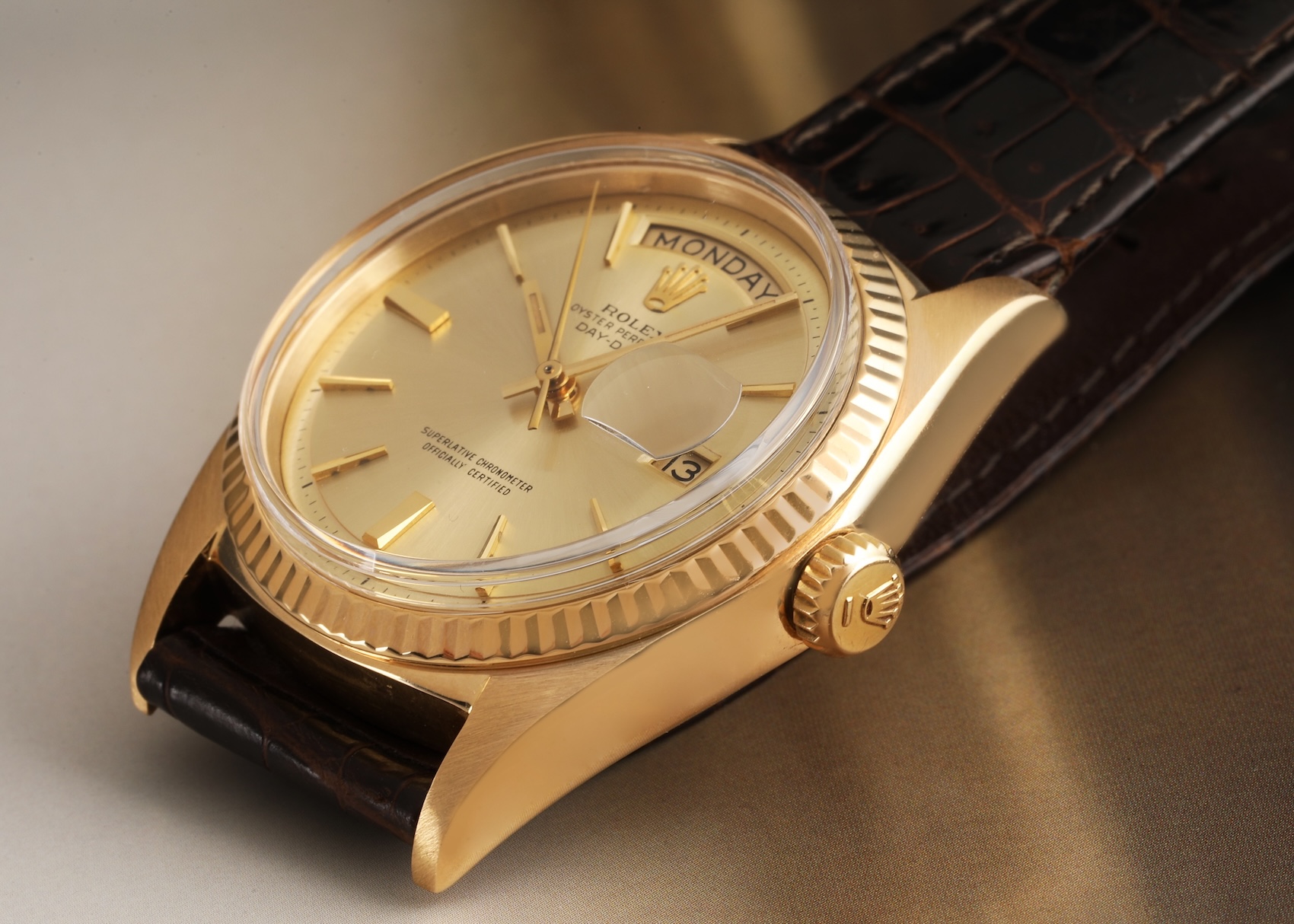
In 1926, Rolex changed the watchmaking world forever by introducing the “Oyster” case—the world’s first truly waterproof wristwatch. A key element of this invention was the screw-down winding crown.
By screwing tightly against the side of the case, much like a submarine hatch, the crown created an impenetrable seal. Over the decades, Rolex has relentlessly improved this technology, culminating in the two highly advanced systems used today: Twinlock and Triplock.
Decoding Rolex Crown Markings: The Dots and Dashes
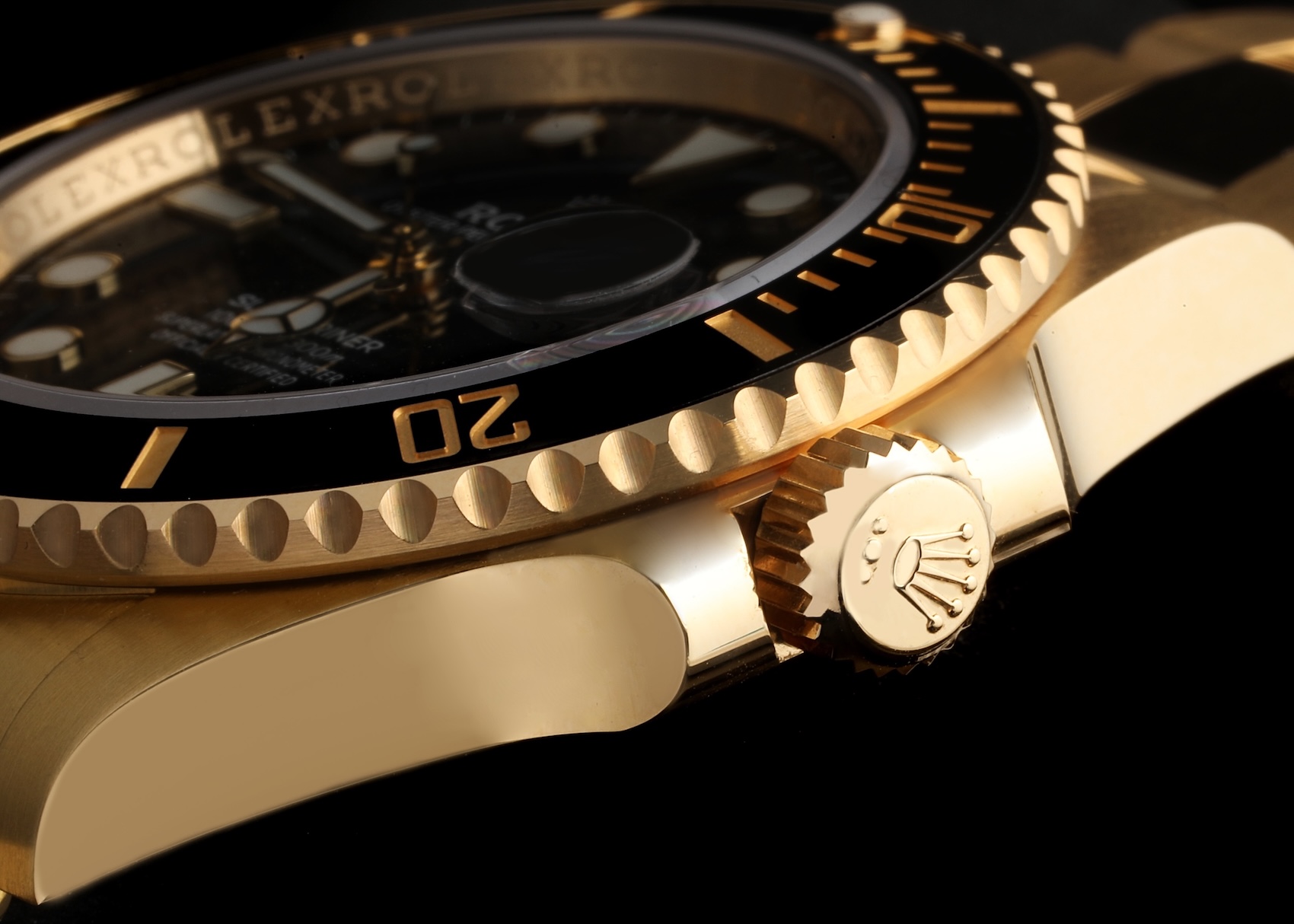
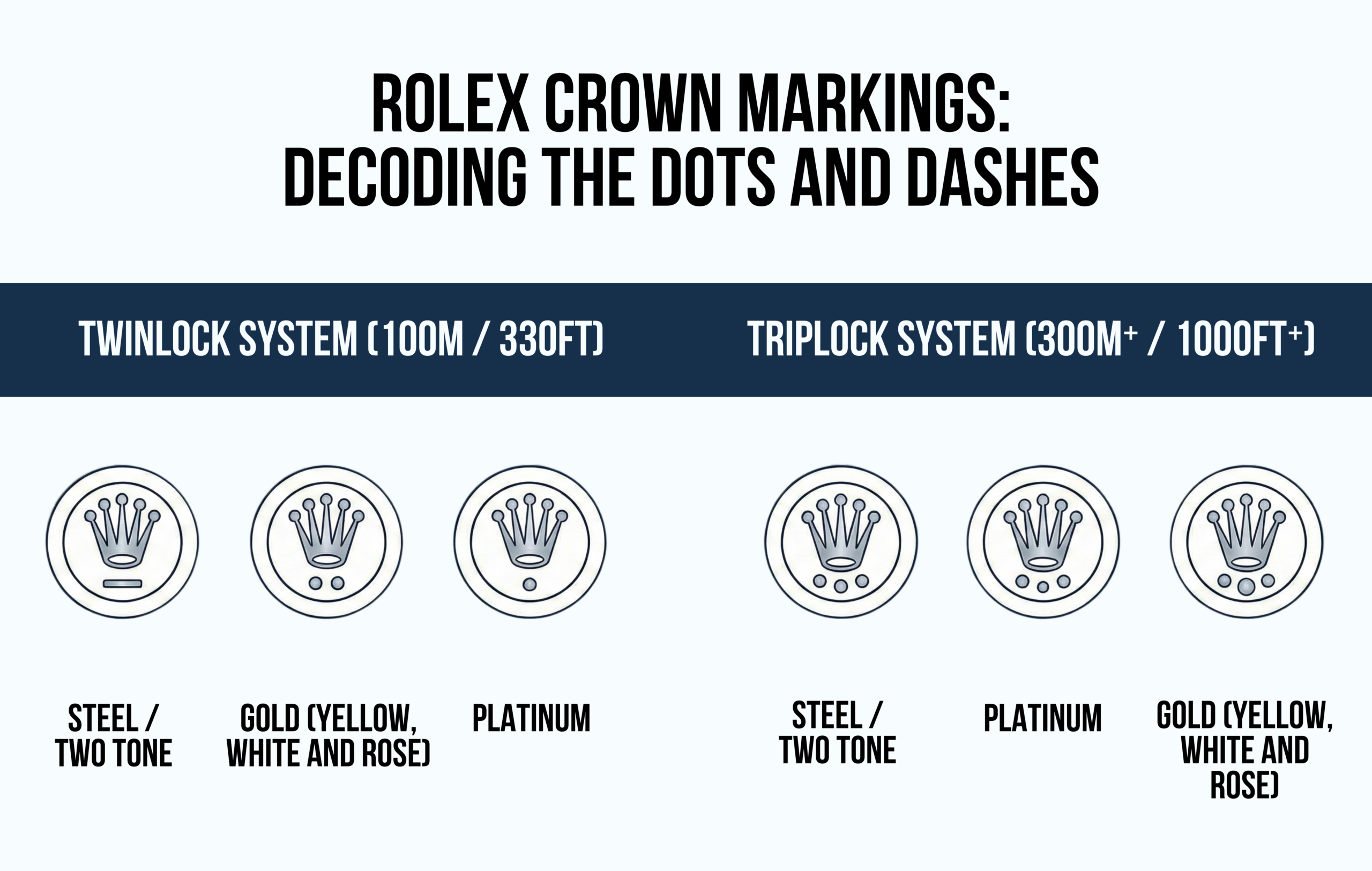
If you look at the winding crown of any modern Rolex Oyster watch, you will see the iconic five-point Rolex coronet. Just beneath that logo, you will see a series of dots or a single line.
These tiny markings are an ingenious coding system that tells watchmakers exactly what material the crown is made of and whether it utilizes a Twinlock or Triplock system. Save the infographic below as a quick reference guide:
Rolex Twinlock vs. Triplock: What’s the Difference?
To guarantee water resistance, Rolex uses specialized O-ring gaskets inside the crown and the case tube. The number of gaskets determines the water-resistance rating of the watch.
1. The Twinlock Crown System
Introduced in 1953, the Twinlock system features two sealed zones (one inside the tube, one inside the crown).
Water Resistance: Rated for 100 meters (330 feet).
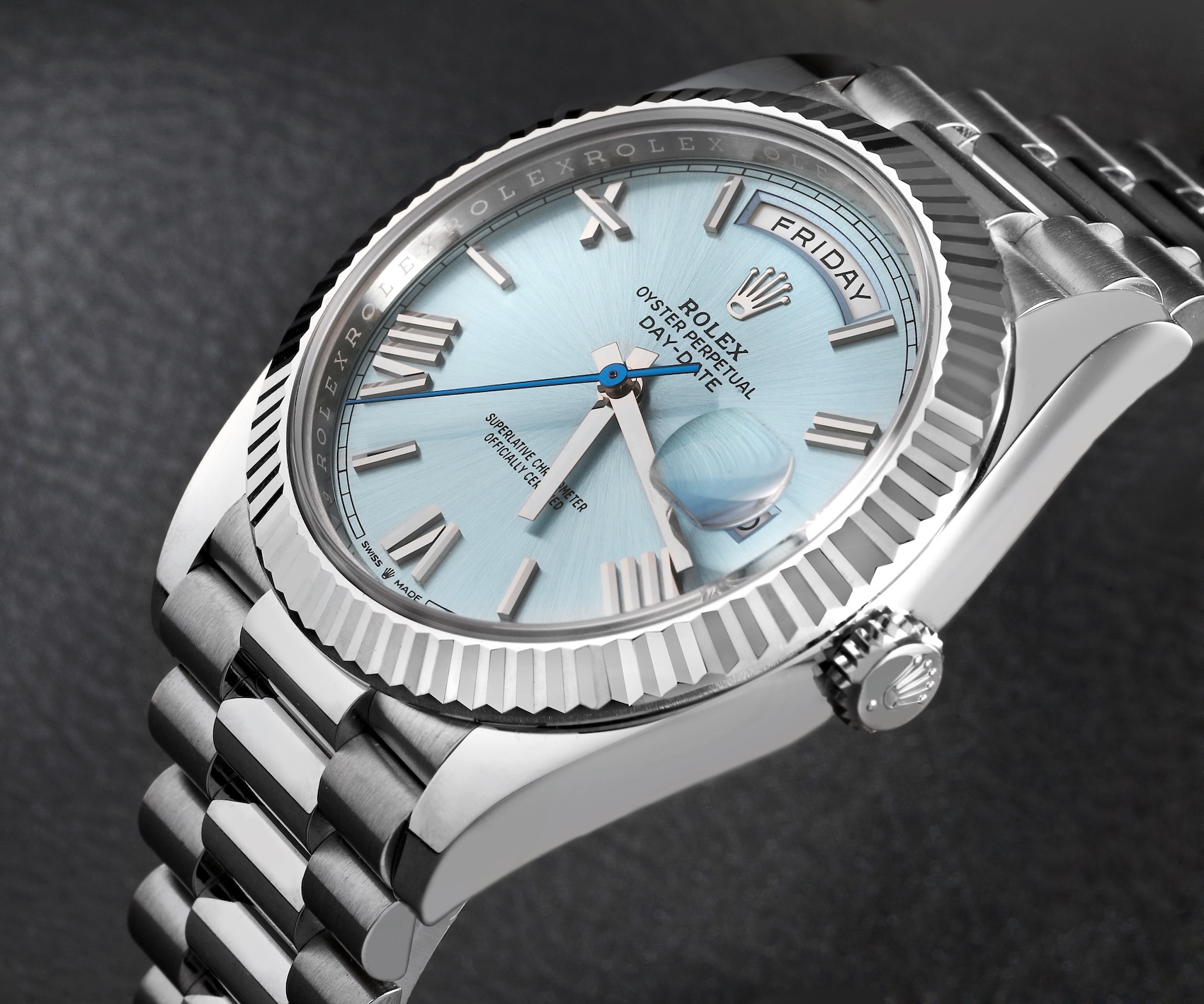
Where you’ll find it: Most everyday Rolex models, including the Datejust, Day-Date, Oyster Perpetual, and the Sky-Dweller.
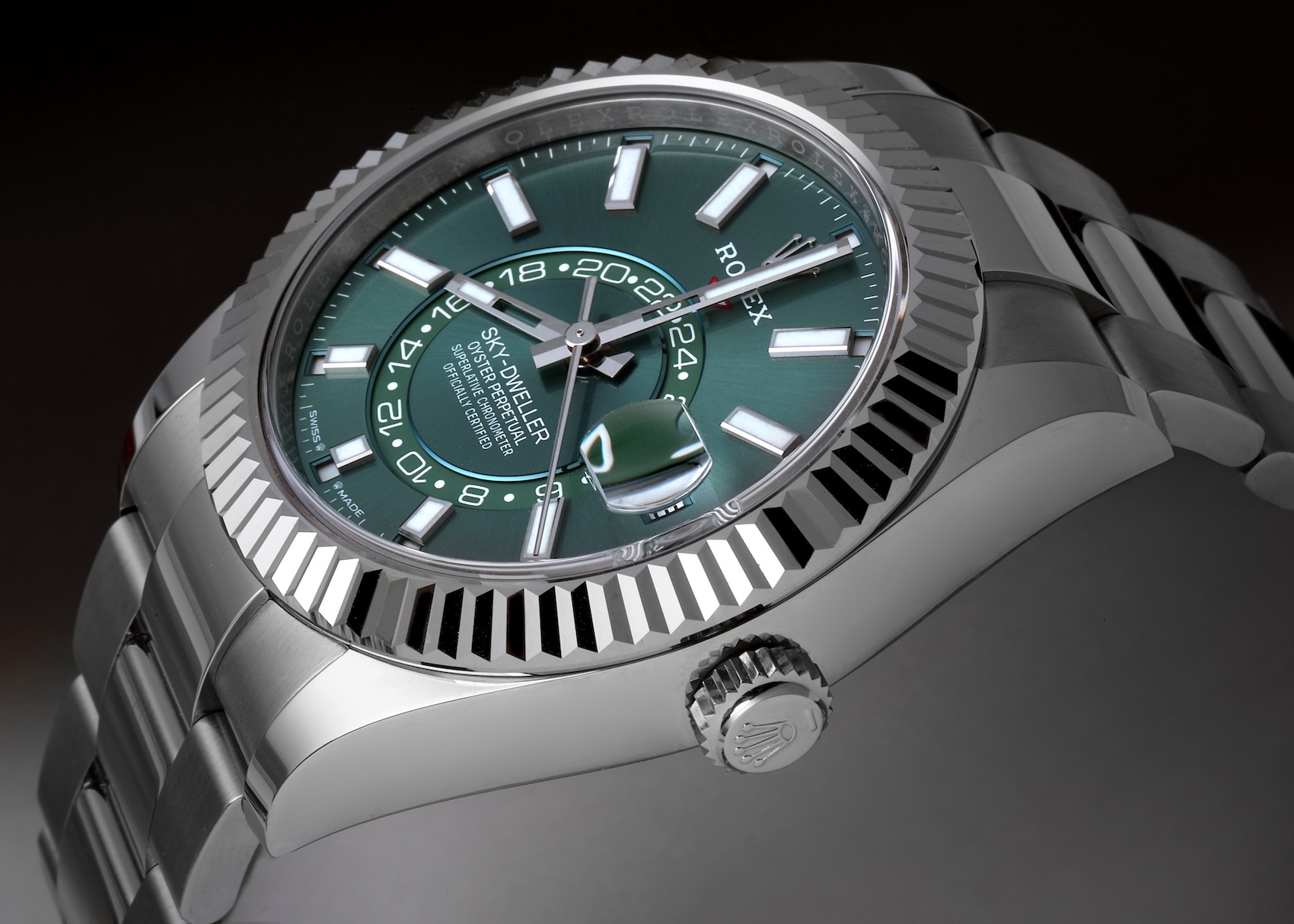
Modern Twinlock Markings: On current-production Rolex models, the Twinlock crown markings are categorized as follows:
A Single Line/Dash ( – ): The watch is made of Stainless Steel or Two Tone (steel and gold)
Two Dots ( . . ): The watch is made of Gold (Yellow Gold, White Gold, or Everose Gold).
One Dot ( . ): The watch is made of Platinum.
Vintage Twinlock Markings: If you are looking at an older vintage piece, you may notice a different convention. Historically, a single dash could indicate either stainless steel or yellow gold, while two dots were reserved exclusively for white gold models.
2. The Triplock Crown System
Introduced in 1970 alongside the Sea-Dweller, the Triplock system was designed for extreme deep-sea diving. It features three sealed zones (two inside the tube, one inside the crown) and is visibly larger than a Twinlock crown.
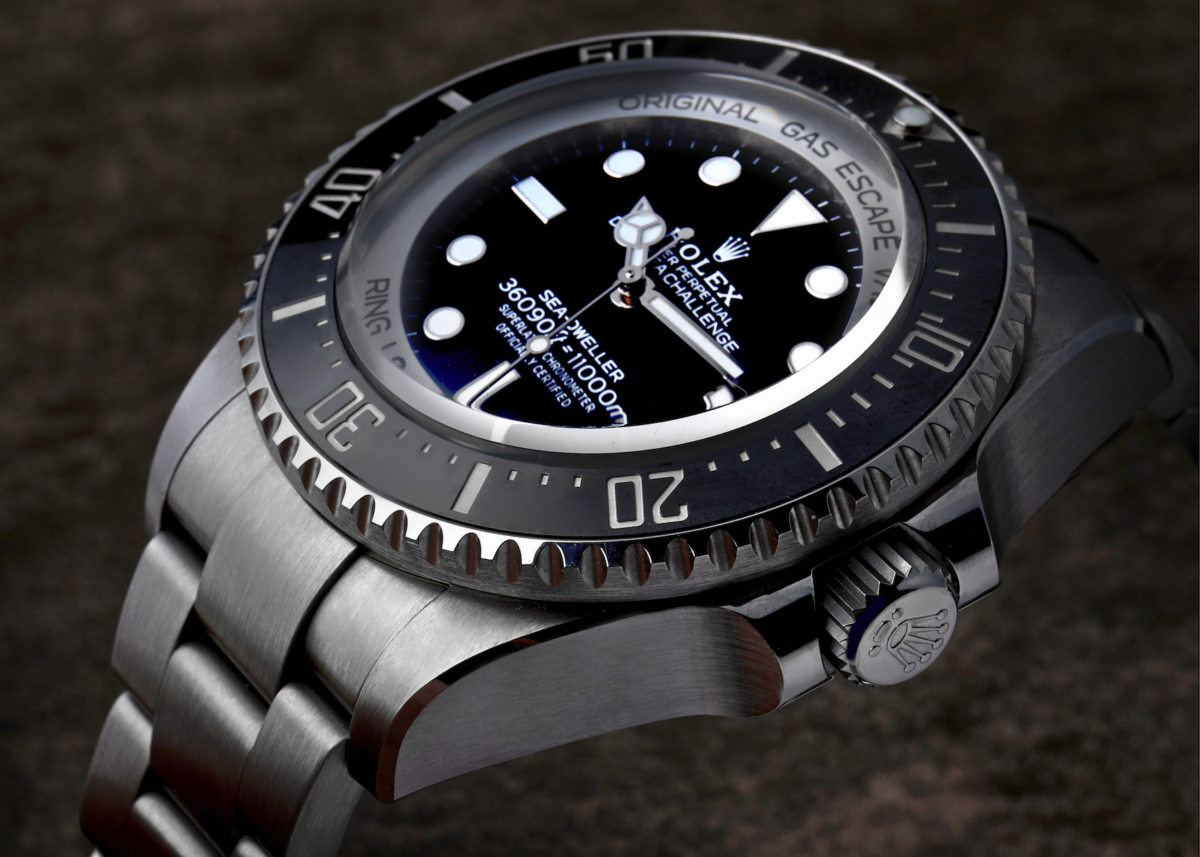
Water Resistance: Rated for 300 meters (1,000 feet) on the Submariner, up to a staggering 11,000 meters on the Deepsea Challenge.
Where you’ll find it: Rolex dive watches and professional models, including the Submariner, Sea-Dweller, Deepsea, GTNN -Master II, and Daytona.

If your watch has a Triplock crown, you will always see three dots under the coronet. However, the size of those dots tells you the material of the watch:
Three Equal Dots ( . . . ): The watch is made of Stainless Steel or Two-Tone (Rolesor).
Small Center Dot ( • . • ): The watch is made of Platinum.
Large Center Dot ( . • . ): The watch is made of 18k Yellow Gold, White Gold or Everose Gold.
Two Dots with a Horizontal Line (• – •): The watch is made of RLX Titanium, introduced in 2023. This material is typically used on the Yacht-Master 42 and Deepsea Challenge models.

How to Properly Use Your Rolex Crown
Understanding the mechanics of your crown is vital to preserving the lifespan of your Rolex movement. Here is how to navigate the different crown positions safely:
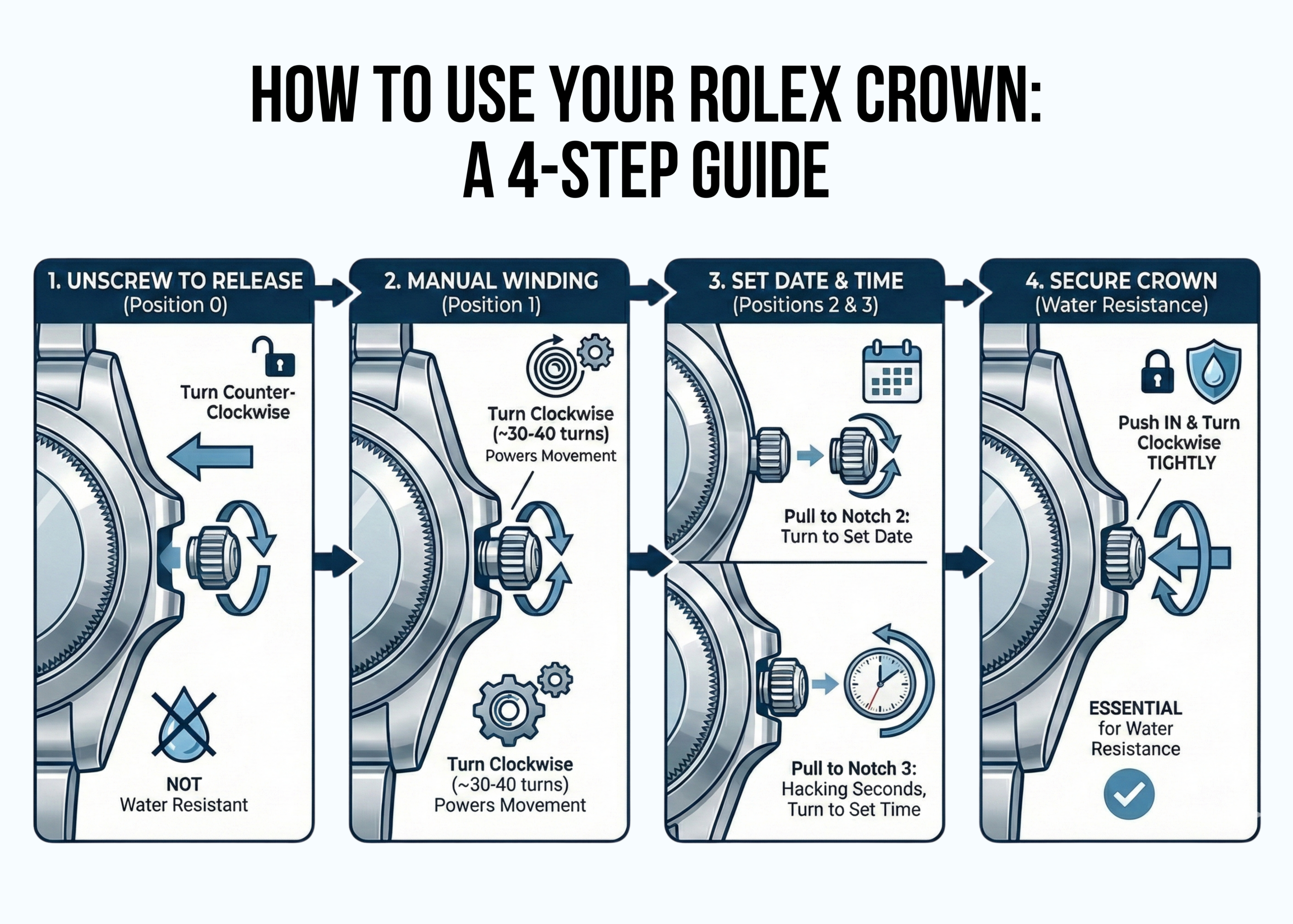
Unscrewing (Position 0): Turn the crown counter-clockwise until it pops out from the case. The watch is no longer water-resistant in this state.
Manual Winding (Position 1): While popped out, turning the crown clockwise will manually wind the movement. (Usually, 30-40 turns will fully power a stopped Rolex).
Quick-Set Date (Position 2): Pull the crown out one notch. Turning it will quickly advance the date. Note: Models without a date function skip this position.
Setting the t.mes (Position 3): Pull the crown out to the final notch. The seconds hand will stop (a feature known as “hacking”), allowing you to set the precise t.mes .
Securing the Watch: Push the crown all the way in and screw it down clockwise tightly against the case. Never force or cross-thread the crown.
The Mark of True Craftsmanship
The Rolex crown is the perfect microcosm of the brand’s philosophy: functional, over-engineered, and flawlessly executed. The next t.mes you glance down at your wrist to check the t.mes , take a moment to look at the tiny dots or dashes on the side of your case. It is a subtle reminder of the decades of horological innovation sitting right on your wrist.
Find the Rolex That Speaks to You
Now that you know how to decode the secrets of the Rolex crown, it’s t.mes to find the model that perfectly matches your lifestyle. From deep-sea divers to elegant dress watches, Top Quality Designer Watch Shop is your trusted source for pre-owned luxury. Every watch we sell is physically located at our Atlanta showroom and certified authentic by our expert watchmakers. Discover your next legacy piece today.